
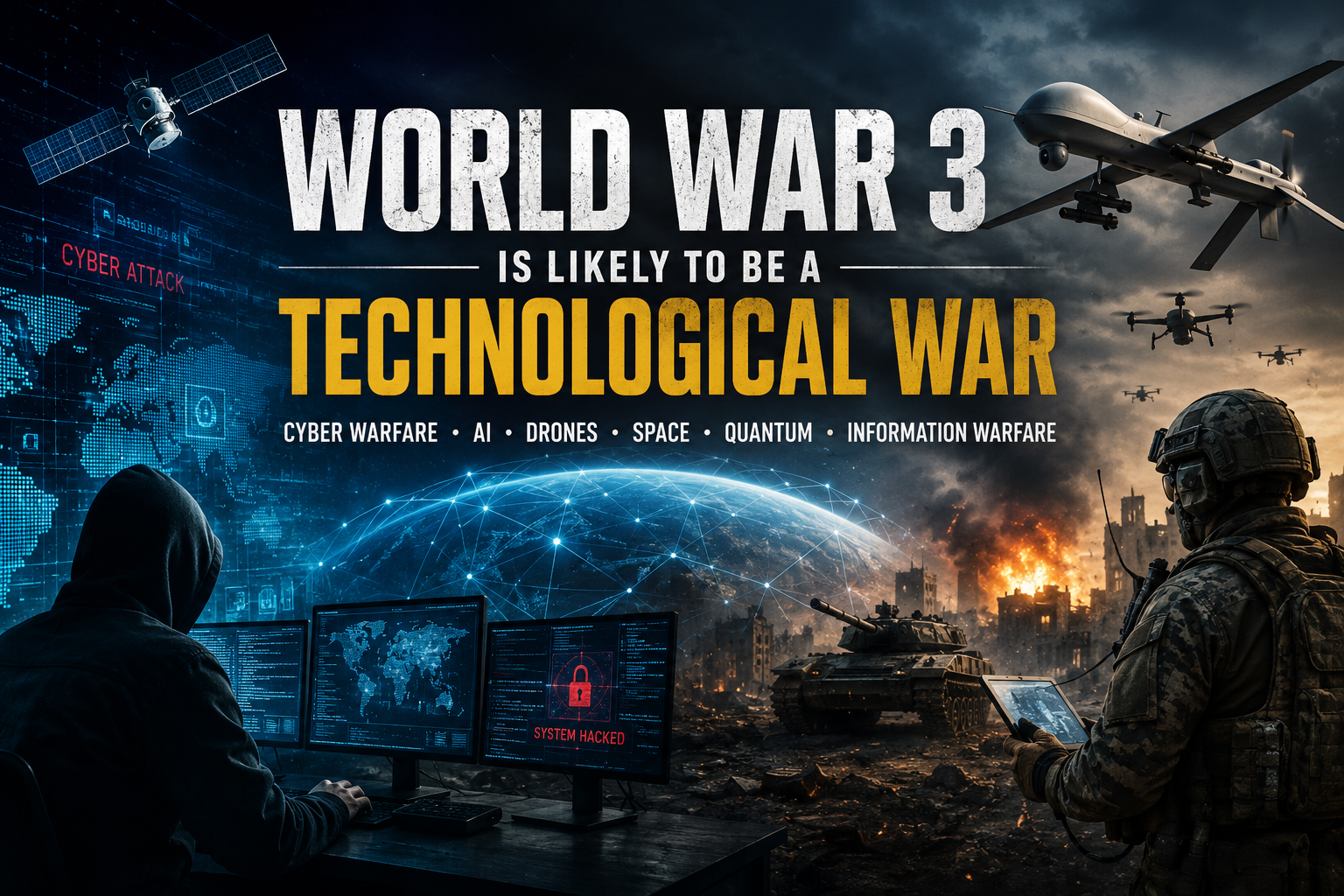
The Battlefield of the Future
For decades, the world imagined that a third world war would be fought with tanks, fighter jets, and massive armies. While traditional military power remains important, the nature of warfare is changing rapidly. If a global conflict were to occur in the future, technology would almost certainly play a central role.
Today’s nations are investing heavily in cyber capabilities, artificial intelligence (AI), autonomous weapons, space technology, quantum computing, and electronic warfare. These innovations are reshaping how conflicts are fought and how countries defend themselves.
Cyber Warfare: The Invisible Battlefield
Modern societies depend on digital infrastructure. Electricity, banking, healthcare, transportation, and communication systems are all connected through networks.
Instead of destroying bridges or factories, attackers could attempt to:
- Disrupt power grids.
- Disable banking systems.
- Interrupt internet and communication services.
- Target hospitals and emergency services.
- Steal classified government or military information.
Cyberattacks can cause widespread disruption without a single missile being launched.
Artificial Intelligence on the Front Line
Artificial intelligence is transforming military decision-making. AI systems can process enormous amounts of information within seconds, helping commanders identify threats and coordinate responses faster than humans alone.
Potential military applications include:
- Autonomous surveillance systems.
- Intelligent drone swarms.
- Faster intelligence analysis.
- Predictive battlefield planning.
- Automated cybersecurity defense.
While AI offers strategic advantages, it also raises ethical concerns about accountability and human oversight.
Drone Warfare
Unmanned aerial vehicles have already changed modern conflicts. Future wars could involve thousands of autonomous drones operating together to perform reconnaissance, logistics, electronic warfare, and precision strikes.
Compared with traditional aircraft, drones are often:
- Less expensive.
- Easier to replace.
- Highly adaptable.
- Capable of operating with minimal risk to human pilots.
Space Could Become a Strategic Domain
Satellites are essential for GPS navigation, communications, weather forecasting, intelligence gathering, and military coordination.
Future conflicts could involve attempts to:
- Disable communication satellites.
- Jam GPS signals.
- Interfere with space-based surveillance systems.
Protecting space infrastructure is becoming an increasingly important national security priority.
Quantum Computing and Encryption
Quantum computing has the potential to revolutionize computing power. Although the technology is still developing, future quantum systems may eventually challenge many of today’s encryption methods.
This possibility is encouraging governments and technology companies to develop quantum-resistant cybersecurity solutions.
Electronic Warfare
Electronic warfare focuses on controlling the electromagnetic spectrum by:
- Jamming communications.
- Disrupting radar systems.
- Blocking GPS signals.
- Protecting friendly communications.
Control of information can be as valuable as control of territory.
Information and Psychological Operations
Social media and digital communication have become powerful tools during conflicts. Governments and other actors may attempt to influence public opinion through misinformation, propaganda, or coordinated information campaigns.
Helping citizens recognize reliable information sources has become an important part of national resilience.
Human Soldiers Will Still Matter
Despite rapid technological advances, human judgment, leadership, diplomacy, and ethical decision-making remain essential. Technology can support military operations, but people continue to make the strategic decisions that determine the course of conflicts.
The Greater Challenge
The greatest technological achievement would not be creating more advanced weapons, but preventing conflicts before they begin. International cooperation, diplomacy, responsible innovation, and strong cybersecurity can all help reduce the risk of future wars.
Technology has the power to protect lives, strengthen societies, and solve global challenges. The same innovations that could be used in conflict can also be used to improve healthcare, education, disaster response, and economic development.
Final Thought
If history teaches us anything, it is that every generation faces new forms of conflict. Whether future technology becomes a force for destruction or a tool for peace will depend on the choices made by governments, industries, researchers, and citizens alike.
The future of warfare may be increasingly technological—but the future of humanity should always be guided by wisdom, cooperation, and a commitment to peace.