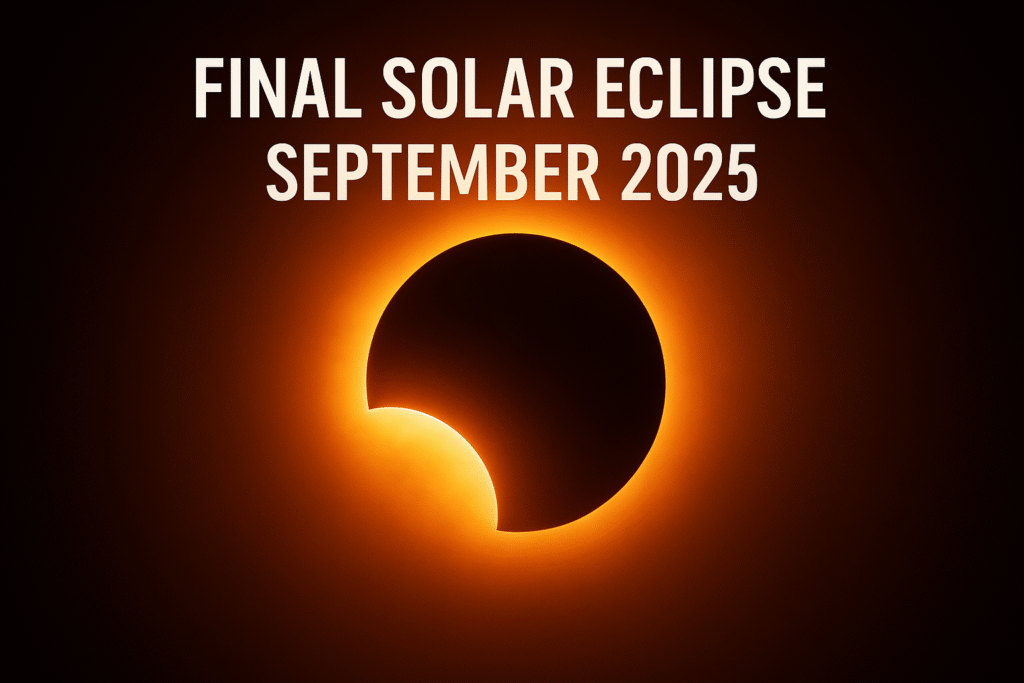
The skies are preparing to put on a breathtaking show this month as the last solar eclipse of 2025 takes place on Sunday, September 21, 2025 (UTC). Though not everyone will be able to witness it directly, the event is already stirring global excitement among scientists, skywatchers, and cultural observers.
What is Happening?
This will be a partial solar eclipse, where the Moon passes between the Earth and the Sun, covering part — but not all — of the Sun’s disk. At maximum, observers in some regions will see the Sun obscured by nearly 85%, leaving a dramatic crescent-shaped glow in the sky.
Where Will It Be Visible?
The eclipse will be best observed in the Southern Hemisphere, including:
- Southern New Zealand – with spectacular sunrise views.
- Eastern Australia – especially coastal areas.
- Pacific Islands – with partial coverage.
- Antarctica – for research stations and explorers in the region.
Most of the Northern Hemisphere, including Africa, Europe, and Asia, will miss out on direct visibility. However, global livestreams will ensure that no one misses the moment.
Timing of the Eclipse (UTC)
- Starts: Around 17:30 UTC
- Maximum Eclipse: Between 19:41 – 19:43 UTC
- Ends: Around 21:54 UTC
In places like New Zealand, the Sun will rise already partially eclipsed, creating a unique dawn experience.
Safety First
Watching a solar eclipse can be dangerous without protection. Do not use regular sunglasses. Instead, use:
- Certified solar eclipse glasses.
- Telescopes/binoculars with approved solar filters.
- Safe indirect viewing methods like pinhole projectors.
Cultural and Astrological Significance
In some traditions, this eclipse coincides with Sarva Pitru Amavasya, a day of honoring ancestors, particularly in India. Astrologers also note that the eclipse falls in the zodiac sign of Virgo, believed by some to influence daily routines, health, and work.
Why It Matters
- It is the final solar eclipse of 2025, marking the year’s last chance to witness this phenomenon.
- For people in regions of visibility, it offers a rare and dramatic natural event.
- For the rest of the world, it is a reminder of the beauty of astronomy and our connection to the cosmos.
🌍 Whether you’re watching the skies in New Zealand, following a livestream in Africa, or reading about it online, this solar eclipse promises to be a fascinating moment in 2025’s astronomical calendar.
We offer Computer Courses You can Apply Now!
other Medical Courses Click this Link to Apply