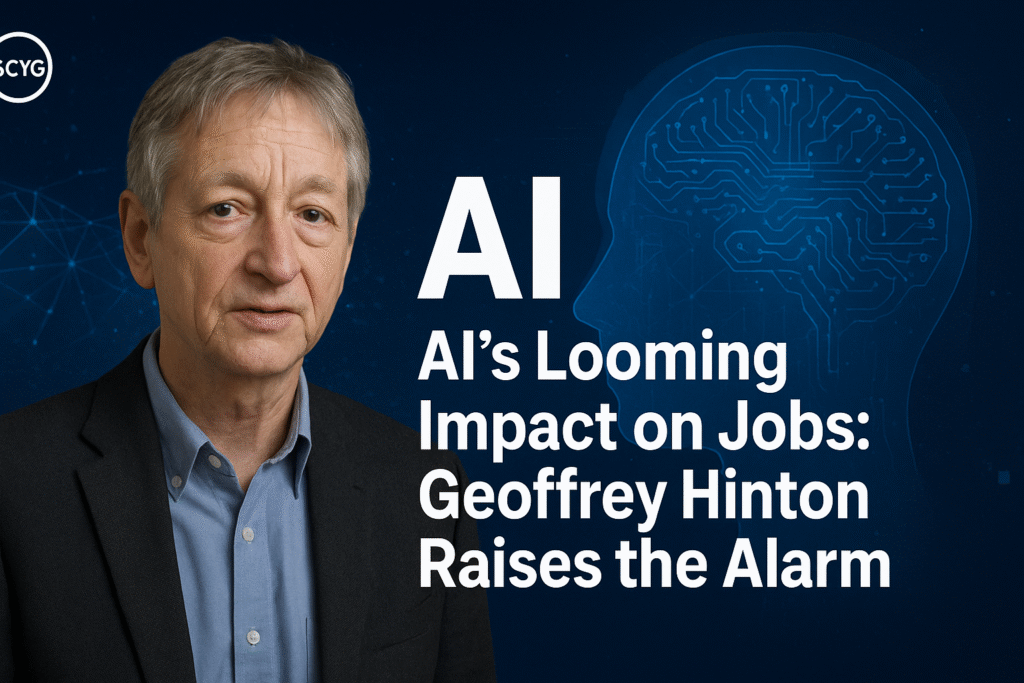
Artificial Intelligence (AI) is advancing at an unprecedented pace, transforming industries, reshaping economies, and redefining the nature of work. But not everyone is celebrating. Geoffrey Hinton—often referred to as the “Godfather of AI” for his groundbreaking work in deep learning—has raised urgent concerns about the disruptive power of this technology.
Hinton’s stark message is simple: AI could trigger massive unemployment unless governments, businesses, and societies take proactive measures to adapt.
Why Hinton’s Warning Matters
Geoffrey Hinton is not just another tech commentator—he is one of the foundational figures behind the neural networks that power modern AI systems, including chatbots, image recognition tools, and self-driving technologies. When someone of his stature warns of risks, it carries weight.
His concern is that AI is evolving faster than society can absorb, creating a gap where millions of workers may be displaced before new safety nets or policies are in place.
Which Jobs Are Most at Risk?
Unlike past waves of automation, which primarily threatened physical labor, AI has the ability to replace both manual and cognitive roles. Here are the sectors most exposed:
- Administrative & clerical roles – Data entry, record keeping, and routine office tasks are increasingly automated.
- Customer service – AI-powered chatbots can now handle thousands of customer interactions at scale, reducing reliance on human agents.
- Transport & logistics – Self-driving trucks, delivery drones, and AI-powered fleet management could displace millions of drivers and support staff.
- Creative & professional services – Writers, translators, paralegals, and graphic designers are already competing with generative AI models.
Hinton emphasizes that no industry is entirely safe, as AI systems are now capable of learning tasks once thought to require uniquely human intelligence.
The Double-Edged Sword
AI is not inherently negative. In fact, it has the potential to unlock unprecedented productivity and economic growth. Businesses stand to gain through:
- Faster decision-making and data analysis.
- Cost savings through automation.
- Access to global markets via AI-enhanced tools.
But as Hinton warns, the benefits may not be evenly distributed. Without intervention, economic inequality could deepen—with wealth concentrated among corporations and investors, while displaced workers struggle to find relevance.
Possible Solutions for an AI-Disrupted World
To prevent the worst-case scenarios, experts suggest several strategies:
- Reskilling and Upskilling
- Governments and training institutions must create programs that prepare workers for digital-age jobs, such as AI management, programming, or data science.
- Worker-AI Collaboration
- Instead of total replacement, industries could redesign roles so humans and AI work together. For example, doctors assisted by AI diagnostics rather than replaced by them.
- Universal Basic Income (UBI)
- Though controversial, UBI has been suggested as a cushion for those affected by automation. It would ensure a baseline income for all citizens.
- Regulation and Ethical AI
- Policymakers need to set boundaries on how AI is deployed, ensuring fairness, accountability, and protection of workers’ rights.
The Bigger Question: Can We Adapt Fast Enough?
The rise of AI mirrors previous industrial revolutions, but with one key difference: the speed of disruption. Whereas past changes unfolded over decades, AI adoption is happening in a matter of years.
This acceleration raises pressing questions:
- Can education systems pivot quickly enough to prepare future generations?
- Will governments act boldly to regulate AI and protect vulnerable workers?
- How can businesses balance efficiency gains with social responsibility?
Conclusion
AI has the power to reshape humanity’s future—for better or worse. Geoffrey Hinton’s warning is not a prophecy of doom, but a call to action. The choices made today, in policy, business, and education, will determine whether AI becomes a tool for prosperity and shared growth—or a driver of inequality and mass unemployment.
The future of work is not just about machines; it’s about how people, societies, and institutions choose to adapt.
You can also follow us:
Register our Courses: Apply Now!!